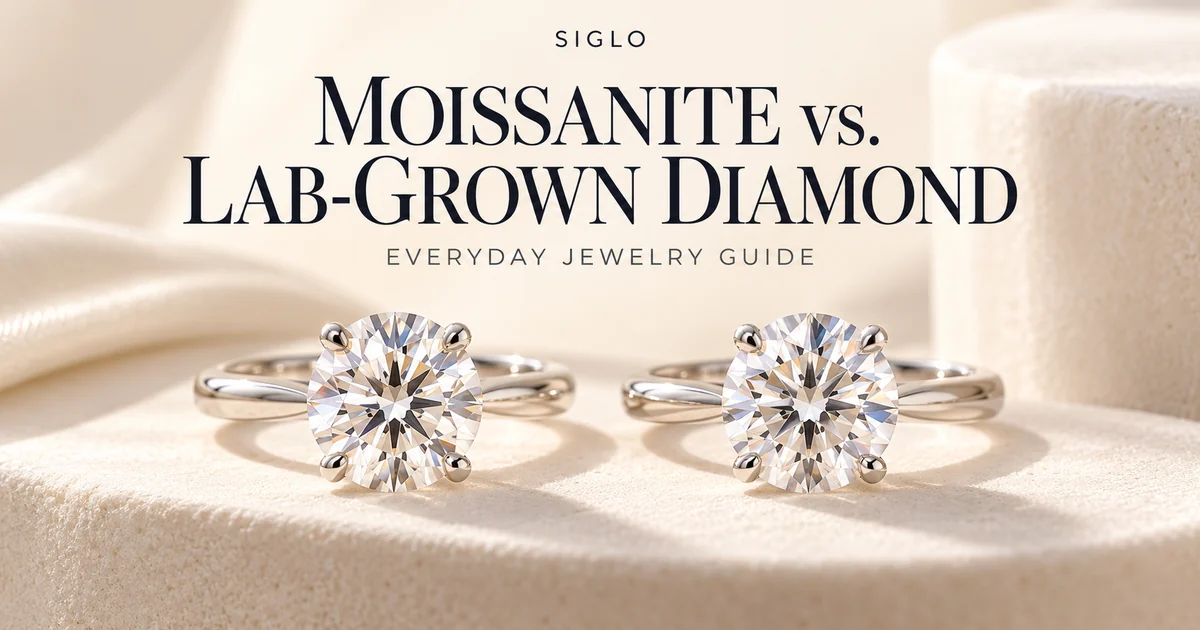
Choosing between moissanite and a lab-grown diamond starts with a personal question: what do you want from the jewelry you will actually wear?
Perhaps you want a pendant that adds sparkle to a simple outfit. Perhaps you are choosing a ring to mark an anniversary, or buying earrings for someone who has always wanted diamonds. Each occasion brings different priorities.
The essential difference is straightforward: a lab-grown diamond is a diamond, while moissanite is a different gemstone. Laboratory-grown diamonds have essentially the same chemical composition and crystal structure as natural diamonds. Moissanite is silicon carbide rather than crystallized carbon. Both can be created in a laboratory, but they are different materials. See GIA’s laboratory-grown diamond guide and GIA’s moissanite research.
Understanding those differences helps you choose a piece that suits your style, budget and daily routine.
Moissanite vs. Lab-Grown Diamond at a Glance
Feature
Moissanite
Lab-Grown Diamond
Gemstone material
Silicon carbide
Crystallized carbon
Appearance
Particularly noticeable rainbow flashes
Diamond’s characteristic brilliance and fire
Mohs hardness
Approximately 9.25
10
Main consideration
Whether you enjoy its sparkle and the complete piece fits your budget
Whether having a diamond matters to you
Details to check
Stone identity, dimensions, metal and setting
Diamond identity, dimensions, metal and available documentation
GIA documents moissanite’s pronounced fire and high hardness, while diamond sits at the top of the Mohs hardness scale. These differences describe the materials; your preference determines which appearance you enjoy. Read GIA’s gemstone comparison and GIA’s diamond simulant guide.
1. Choose the Sparkle You Enjoy
Moissanite is known for its colorful flashes, called fire. This effect can become particularly noticeable in larger stones. For someone who enjoys lively rainbow sparkle, that appearance can be the reason to choose moissanite. GIA explains moissanite’s appearance.
A lab-grown diamond offers diamond’s optical properties with a laboratory origin. It is a suitable choice when you specifically want a diamond rather than another gemstone with a similar appearance. Learn more in GIA’s explanation of natural and laboratory-grown diamonds.
When shopping online, ask to see the actual jewelry in daylight and indoor lighting. A short video can help you judge the appearance beyond a single photograph taken under bright display lights.
Consider the whole piece:
For earrings: look at the pair being worn to understand its proportions.
For a necklace: check the pendant dimensions and chain length together.
For a ring: examine the view from above and the side profile.
A close-up photograph shows details, but it does not tell you everything about how the jewelry will look on you.
2. Compare the Complete Price
Start with the total amount you are comfortable spending. Then compare pieces with similar stone dimensions, metal specifications and designs.
Moissanite is generally more affordable than lab-grown diamond in comparable gemstone offerings. However, this general difference does not determine the price of every finished piece. See Brilliant Earth’s gemstone price comparison.
Before comparing two prices, check what each listing includes:
The identity of the main gemstone and any accent stones.
Stone measurements in millimeters.
Whether a stated carat figure means individual stone weight, total stone weight or diamond-equivalent size.
The metal specification and any plating.
Accessories, such as a necklace chain.
Available documentation.
Delivery costs and return conditions.
For example, two rings may have a similar appearance but different metals, stone dimensions or included services. Comparing only the headline price can hide those differences.
The useful question is: what am I receiving for the complete price?
3. Consider Your Daily Routine
Both moissanite and diamond have high resistance to scratching. However, hardness does not mean a gemstone or its setting cannot be damaged. GIA explains that even diamond can chip or break when struck in a vulnerable direction. Read GIA’s diamond durability guide.
For an everyday ring, examine the setting as carefully as the stone. Ask about:
How high the gemstone sits above the finger.
Whether the design feels comfortable for your activities.
How the stone is secured.
The care required by the metal and finish.
If you regularly wear gloves or work with your hands, mention your routine when asking the seller for advice.
For earrings and necklaces, consider weight, fastening and proportions. A piece that feels comfortable and suits your wardrobe is more likely to become something you reach for regularly.
Follow care instructions for the complete piece of jewelry. A design containing different gemstones or finishes may require different treatment. GIA cautions that ultrasonic cleaning can loosen stones or damage certain gem materials. See GIA’s jewelry care advice.
4. Match the Gemstone to the Occasion
For a Gift
Find out whether the recipient wants a diamond specifically or simply enjoys sparkling jewelry.
Someone who loves colorful flashes may appreciate moissanite. Someone who has expressed a wish for diamond earrings may prefer a lab-grown diamond.
Describe the gemstone accurately. Clear information helps the recipient understand and appreciate the piece you have chosen.
For an Anniversary or Milestone Ring
Discuss three things together: the gemstone, the design and the budget.
Does having a diamond carry personal meaning? Is a particular shape more appealing? Would a smaller stone in a favorite setting feel more special than a larger stone in a less suitable design?
These questions can guide a more personal choice than gemstone size alone.
For an Everyday Treat
Begin with how you want to wear the jewelry.
You might want a pendant for a simple neckline, earrings to pair with your existing necklace, or a ring that fits comfortably alongside another band.
Once you know the role the piece will play, choosing the gemstone becomes easier.
5. Check These Details Before Ordering
Keep this checklist beside the product page:
What is each gemstone? Check the center stone and accents separately.
What are the measurements? Use dimensions rather than photographs alone.
What is the metal? Read the material and finish specifications.
What documentation is included? Ask whether any report applies to the actual stone in the piece.
What happens if it does not fit? Review sizing and return conditions before ordering.
For diamond identification, professional testing matters. GIA explains that distinguishing laboratory-grown from natural diamonds reliably requires specialized methods. A casual visual inspection does not replace that identification. Read GIA’s explanation of diamond identification.
Frequently Asked Questions
Is Moissanite a Lab-Grown Diamond?
No. Moissanite and lab-grown diamond are different gemstone materials. A laboratory origin describes how a stone was made; it does not make every laboratory-created stone a diamond. See GIA’s explanation of simulants and laboratory-grown diamonds.
Are Lab-Grown Diamonds Real Diamonds?
Yes. Their origin differs from natural diamonds, but they have essentially the same chemical, optical and physical properties. Read GIA’s laboratory-grown diamond explanation.
Does Moissanite Sparkle More Than Diamond?
Moissanite displays more fire, meaning colored flashes. Whether that looks better is a matter of personal preference. Compare actual pieces under different lighting and choose the effect you enjoy. GIA explains moissanite’s fire.
Which Is Better for Daily Wear?
Both stones have high hardness. Your decision should also consider the setting, comfort and care requirements of the complete piece. Choose the gemstone appearance you prefer, then evaluate whether the jewelry suits your routine. See GIA’s gemstone durability comparison.
Find the Piece You Want to Wear
Choose moissanite if you enjoy its sparkle and find a piece that meets your needs. Choose a lab-grown diamond if having a diamond matters to you and you find a design within your budget.
At SIGLO, begin by exploring our rings or silver rings. Read each product’s gemstone and metal specifications, then visit the SIGLO Jewelry Guide for help with sizing and buying questions.
Your next piece should feel right for the way you dress, the moments you want to celebrate and the budget you choose.
Send us your creative ideas. We produce design drafts for review. After confirmation, we complete handcrafting, engraving and gemstone inlay. Strict quality control is performed before delivery to realize your exclusive silver jewelry