Does a lower price mean the stone is not a diamond? When comparing diamond vs cubic zirconia, price alone cannot answer that question. A sparkling piece may contain a lab-grown diamond, cubic zirconia or another gemstone—and each should be clearly identified.
Lab-grown diamonds can make diamond jewelry more accessible. However, they are different from cubic zirconia. Understanding that difference helps you choose a piece for its actual material, appearance and design.
Diamond vs Cubic Zirconia: The Main Difference
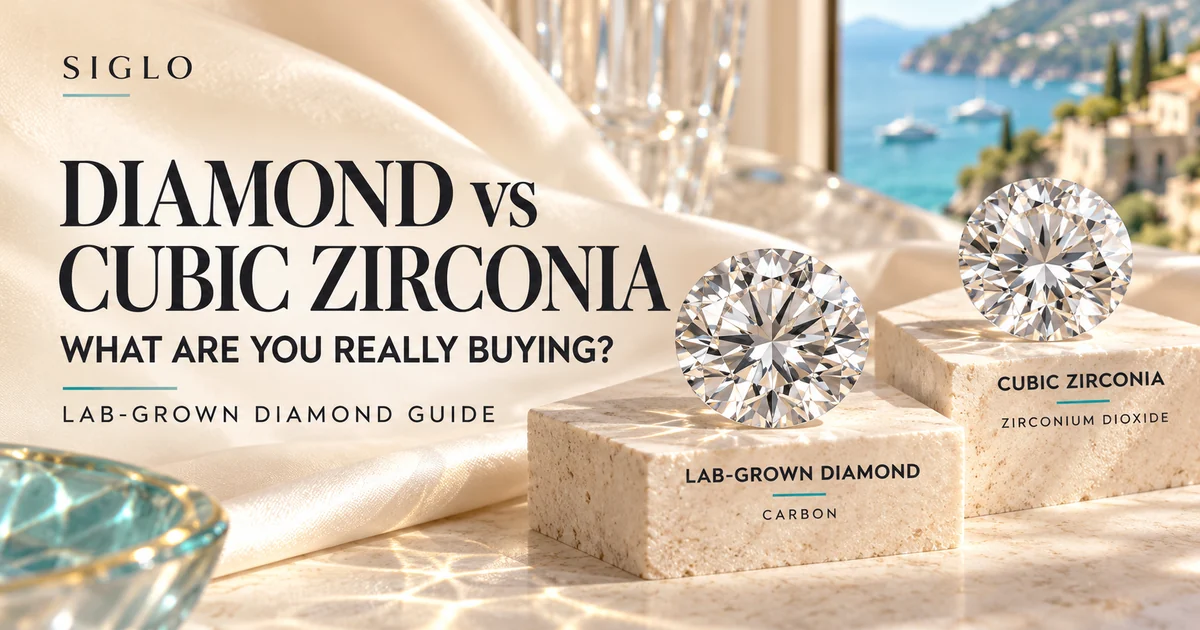
The main difference is the material. Diamond is crystalline carbon. Cubic zirconia, often abbreviated as CZ, is a zirconium dioxide-based material used as a diamond simulant.
Lab-grown diamonds and natural diamonds share the same carbon crystal structure and nearly the same chemical, physical and optical properties. Their growth origin differs. CZ has a different composition and different properties.
Read more in GIA's explanation of lab-grown diamonds and simulants.
| Feature | Lab-Grown Diamond | Cubic Zirconia |
|---|
| Material | Crystalline carbon | Zirconium dioxide-based material |
| Classification | Diamond with a laboratory growth origin | Diamond simulant |
| Relationship to natural diamond | Shares the same diamond crystal structure | A different material that can resemble diamond |
| Scratch hardness | 10 on the Mohs scale | Approximately 8–8.5 on the Mohs scale |
| Buying consideration | Confirm diamond identity, laboratory origin and available quality information. | Confirm CZ disclosure, setting, finish and care requirements. |
GIA describes CZ's composition and hardness in its guide to imitation gem materials.
Are Lab-Grown Diamonds Cubic Zirconia?
No. Growing a gemstone in a laboratory does not automatically make it cubic zirconia. The name of the material matters.
“Lab-grown diamond” identifies diamond with a laboratory growth origin. “Cubic zirconia” identifies CZ. A broad phrase such as “lab-created gemstone” does not, by itself, tell you which material a product contains.
When shopping, look for a specific stone description. It should make clear whether the center stone is a lab-grown diamond, natural diamond, moissanite, cubic zirconia or another gemstone.
Can Cubic Zirconia Sparkle Like a Diamond?
CZ can have an attractive sparkling appearance, but its optical properties differ from diamond. GIA notes that CZ can display slightly more fire—the colored flashes of light—while having less brilliance than diamond.
That difference does not tell you which appearance you will personally prefer. Some buyers enjoy colorful flashes; others want diamond's particular combination of light reflections.
Explore GIA's guide to simulated diamonds for more information.
Review clear photographs and a video when available. Use them to judge the appearance you enjoy, while relying on accurate product information and appropriate testing for material identity.
Diamond vs Cubic Zirconia: What Does the Price Tell You?
CZ is generally an affordable gemstone option. Lab-grown diamonds are often available at a lower price point than comparable natural diamonds. These are different reasons a jewelry price may be accessible.
A finished piece also includes more than its center stone. Metal, accent stones, setting construction, finish and design all contribute to the purchase.
A low price does not prove that a stone is CZ, and a high price does not prove that it is diamond. Compare the specific materials and complete piece rather than treating price as a test of authenticity.
Compare Size and Wear, Too
When comparing diamond vs cubic zirconia jewelry, review the stone's measurements in millimeters. Do not assume that matching carat numbers mean matching visible dimensions across different materials.
For rings, also look at the setting height, band width and how the piece may fit your daily routine. Scratch hardness is one consideration; the security and condition of the complete setting matter as well.
Read the care instructions for the whole piece, including any plating, accent stones and other materials. Choose a design you can comfortably wear and care for.
What Should You Check Before Buying?
- Center-stone identity: Is the material named clearly?
- Accent stones: Are the side stones identified separately?
- Diamond origin: If the stone is diamond, is it described as natural or laboratory-grown?
- Weight and dimensions: Is the carat figure for the center stone or the combined stones?
- Metal and finish: Is the piece silver, gold, plated metal or another material?
- Documentation: Is an independent gemological report included, if that matters to you?
- Returns: Are the return conditions and sizing options clear?
If important information is missing, ask before ordering. GIA explains that gemological identification uses scientific measurements and, where needed, advanced instruments. Appearance alone should not establish a stone's identity.
Learn about the identification process in GIA's laboratory-grown diamond guide.
Explore Lab-Grown Diamond Designs at SIGLO
If you want to explore diamond material within an accessible jewelry budget, start with SIGLO's clearly described lab-grown diamond designs.
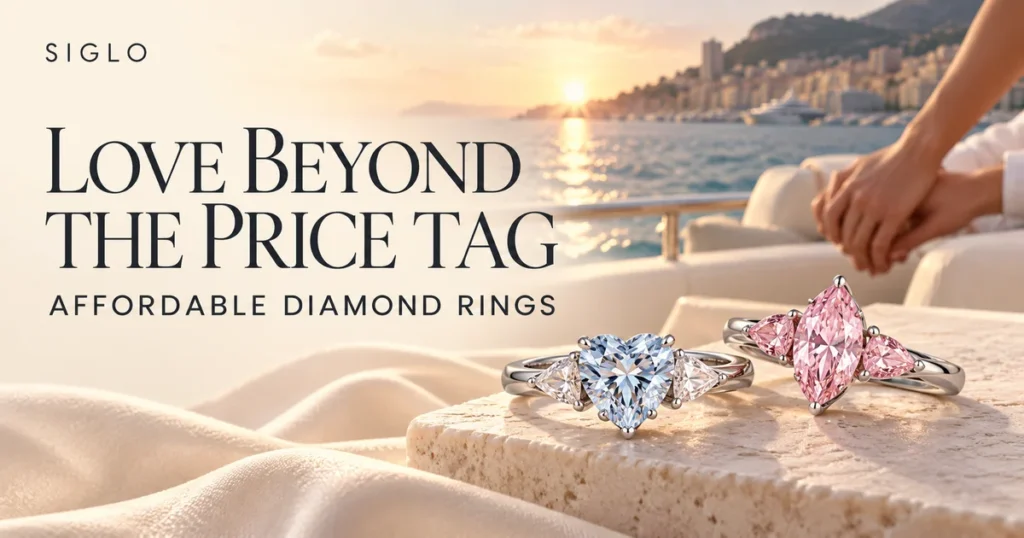
The Azure Devotion heart-shaped ring offers an ice-blue heart design, while the Rosé Promise pink marquise ring offers a colorful three-stone silhouette. Their product listings describe lab-grown diamonds in S925 sterling silver settings.
Review each product's current specifications, photographs and available documentation before choosing. A general link to diamond education does not mean a particular piece includes an independent grading report.
You can also browse SIGLO's ring collection, which includes different gemstone types and designs.
Frequently Asked Questions
Is Cubic Zirconia a Lab-Grown Diamond?
No. CZ and lab-grown diamond are different materials. Laboratory production alone does not make them the same gemstone.
Can Lab-Grown Diamonds Be More Affordable Than Natural Diamonds?
Yes. Lab-grown options are often available at a lower price point than comparable natural diamonds. The exact difference depends on the stones and finished pieces.
Can I Identify the Material from a Product Photo?
A photograph can help you assess design and visible appearance, but it should not establish gemstone identity. Check the specific description and appropriate documentation.
Should I Choose Diamond or CZ?
Choose according to the material you want, your preferred appearance, the complete design and your budget. Clear disclosure lets you make an informed choice.
Choose the Sparkle with Clear Information
The comparison of diamond vs cubic zirconia starts with understanding what each material is. Lab-grown diamond gives you diamond material with a laboratory origin; CZ offers its own sparkling appearance as a different gemstone.
Explore Azure Devotion, Rosé Promise or SIGLO's ring collection to find a design that suits you.
Choose a piece because you understand its material, enjoy its appearance and feel comfortable with its price.