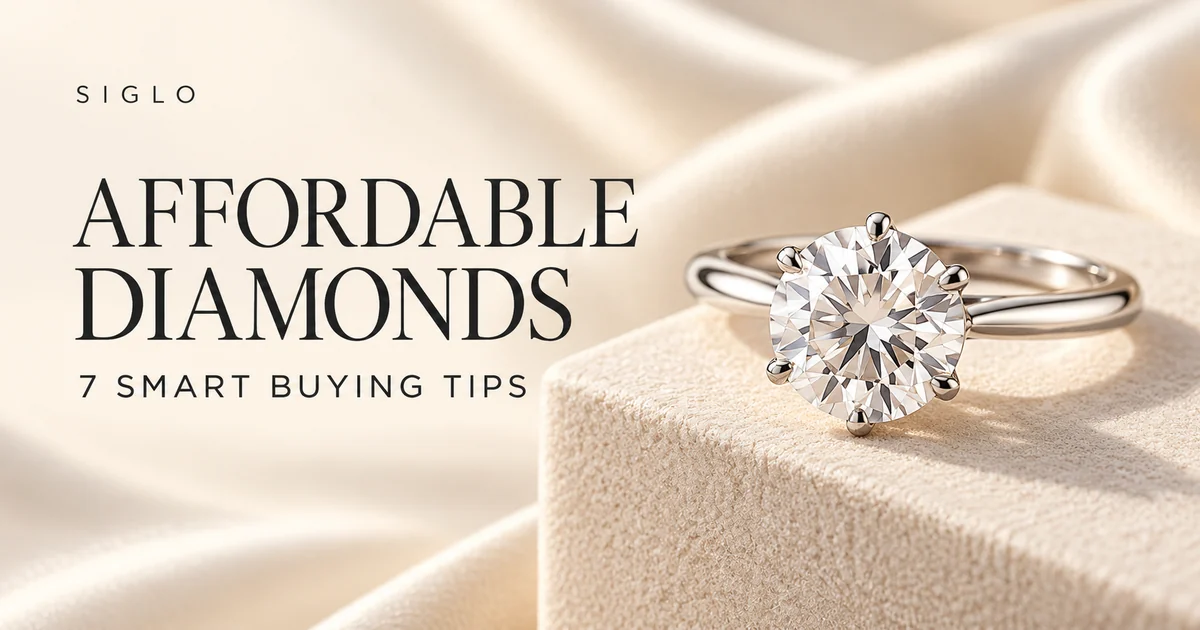
Beautiful diamond jewelry does not have to begin with the biggest budget. Whether you are buying your first diamond ring, choosing a meaningful gift or treating yourself to an everyday pendant, a few informed decisions can help you find a piece you love at a price you feel comfortable paying.
The key to buying affordable diamonds is understanding what you are paying for: the gemstone, its appearance, the setting and the complete purchase experience.
This guide explains seven practical ways to compare your options and choose diamond jewelry that fits your budget.
1. Set a Budget for the Complete Piece
Before looking at diamond sizes or grades, decide how much you want to spend on the finished jewelry.
A loose diamond price is only part of the picture. Your final cost may also include the setting, chain, resizing, delivery and applicable taxes or import charges.
Write down three things before you shop:
- Your total spending limit: the amount you are comfortable paying at checkout.
- Your main priority: sparkle, size, gemstone origin or a particular design.
- Your intended use: an engagement ring, an occasional accessory or everyday jewelry.
This gives you a clear way to compare options. If one piece exceeds your budget, you can decide which feature to adjust rather than increasing your spending automatically.
2. Consider Lab-Grown Diamonds
If having a diamond matters to you but natural origin is not essential, lab-grown diamonds are worth comparing.
Lab-grown diamonds are diamonds. They have essentially the same chemical composition, crystal structure and optical properties as natural diamonds, with a different growth origin. GIA describes laboratory-grown diamonds as offering options at a reduced price point.
You can learn more in GIA’s explanation of laboratory-grown diamonds and simulants.
Compare actual quotations for pieces with similar specifications. The price difference depends on the stones, settings and sellers involved, so a fixed discount percentage should not replace a proper comparison.
Also check the gemstone description carefully. Moissanite and cubic zirconia can offer attractive sparkle, but they are different materials. They should not be confused with lab-grown diamonds.
3. Give Cut Quality Serious Attention
A larger diamond is not automatically the more attractive diamond.
Cut describes how a diamond has been fashioned, including its proportions and finish. It affects how the stone interacts with light and contributes to its brightness, fire and sparkling appearance. GIA explains these relationships in its diamond quality guide.
When choosing between two stones, ask to see both under similar lighting. Look at their appearance rather than comparing only their carat weights.
For online purchases, request:
- A clear video of the actual stone or finished piece.
- Views in ordinary indoor lighting and daylight.
- The available cut information and stone measurements.
- A side view showing the setting and its height.
If a larger stone looks less appealing to you than a smaller option, consider whether the extra weight is worth the price difference.
4. Compare Carat Weights Around Popular Thresholds
Carat measures a diamond’s weight, not its visible dimensions. Two stones with similar weights can have different measurements and appearances.
GIA also explains that popular weights such as 1.00, 1.50 and 2.00 carats can carry a price premium. A stone just below a threshold may offer a useful comparison, particularly when shopping for natural diamonds. Read GIA’s carat weight guide.
For example, if you are considering a one-carat diamond, compare it with suitable stones slightly below that weight. Check their actual dimensions, appearance and prices rather than assuming a particular saving.
For rings with several stones, check whether the listed weight refers to:
- The center diamond alone.
- The combined weight of all diamonds.
- The total gemstone weight, including other materials.
A ring with one carat of total diamond weight is different from a ring with a one-carat center diamond.
5. Choose Color and Clarity for the Appearance You Want
The highest grade on paper may not be necessary for the look you want.
For natural round brilliant diamonds, GIA identifies G–H color and VS2 clarity, along with some individually assessed SI1 stones, as options budget-conscious buyers can consider. These are starting points for comparison, not guarantees that every stone will look the same. See GIA’s round diamond buying guide.
Ask whether inclusions are visible to the unaided eye at an ordinary viewing distance. Compare color in the type of setting you intend to buy.
A seller’s description of a diamond as “eye-clean” should be checked against the actual stone. Your viewing conditions, the diamond’s size and the location of its inclusions all deserve attention.
For colored diamonds, choose according to the color you enjoy and the applicable report. Advice for colorless diamonds does not automatically apply to pink, blue or other fancy-colored stones.
6. Compare Settings as Carefully as Stones
You are buying a piece of jewelry, so include the setting in your value comparison.
If you like a simple solitaire, ask for a quotation for that design before adding accent stones or decorative details. If you prefer a halo or a cluster, check the gemstone identity and weight of the smaller stones as well as the center.
Read the metal specification carefully. Sterling silver, gold-plated silver, solid gold and platinum are different materials and should be compared accordingly.
Consider the practical details too:
- Does the ring fit comfortably?
- Is the necklace chain included?
- Are the earrings a suitable weight for you?
- What care does the metal or finish require?
- Can the piece be resized or repaired if needed?
A design that suits your routine can be a better purchase than one chosen only for an impressive gemstone size.
7. Check Documentation and Purchase Terms
A low price is easier to assess when the product description is clear.
Before ordering, confirm the diamond’s origin, stated specifications and any disclosed treatments. Ask what independent documentation is included and whether it applies to the actual stone you will receive.
Report formats differ. GIA’s current services use a Premium or Standard quality assessment for eligible loose colorless-to-near-colorless lab-grown diamonds, while laboratory-grown colored diamonds have a separate report service. Check the report type and issue date. See GIA’s laboratory-grown diamond services.
Documentation helps identify and describe a stone; it does not establish that a seller’s price is the lowest available.
Also read the return policy, delivery information and any exclusions for customized or resized jewelry. The FTC recommends researching sellers and obtaining their return and refund policies in writing. Read its jewelry buying advice.
Your Affordable Diamond Buying Checklist
Before checkout, make sure you can answer these questions:
- Is the stone a natural diamond, a lab-grown diamond or a different gemstone?
- Does the final price fit my complete budget?
- Have I compared the actual appearance and dimensions?
- Does the carat figure describe the center stone or total weight?
- Are the metal and setting details clearly stated?
- What documentation is included?
- Do I understand the delivery, sizing and return terms?
Frequently Asked Questions About Affordable Diamonds
Are Affordable Diamonds Always Low Quality?
No. A lower price may reflect a laboratory origin, smaller carat weight, different quality characteristics or a less expensive setting. Read the specifications and compare the actual pieces to understand the difference.
Are Lab-Grown Diamonds a Good Option on a Budget?
They are worth comparing if you want a diamond and are comfortable with a laboratory origin. Choose according to the stone’s appearance, documentation and complete price rather than origin alone.
Should I Buy a Smaller Diamond to Save Money?
A smaller diamond is one option to explore. Compare dimensions and appearance alongside price, especially around popular carat thresholds. Choose the size you enjoy wearing rather than a weight you feel expected to buy.
Can I Buy Diamond Jewelry Online?
Yes, but request clear specifications, actual product images or videos and written purchase terms. If an important detail is missing, ask the seller to clarify it before ordering.
Find Diamond Jewelry That Fits Your Budget
Buying affordable diamonds begins with choosing what matters most to you. Set a complete budget, compare gemstone origins, examine the appearance and check the details of the finished piece.
At SIGLO, explore our ring collection and read each product’s gemstone and metal specifications. For more help with materials, sizing and choosing jewelry, visit the SIGLO Jewelry Guide.
Choose a piece you enjoy wearing, with clear information and a price that feels right for you.