A bigger-looking diamond ring does not always require a bigger budget. When comparing oval vs round diamonds, the shape you choose can change how much presence a ring has on your hand. Lab-grown diamonds also give budget-conscious buyers another way to explore diamond jewelry.
But which shape looks bigger, and what makes a diamond sparkle? Before choosing the highest carat number, compare the stone's dimensions, appearance and complete setting. The best choice brings together a look you love and a price you feel comfortable paying.
Oval vs Round Diamonds: The Quick Comparison
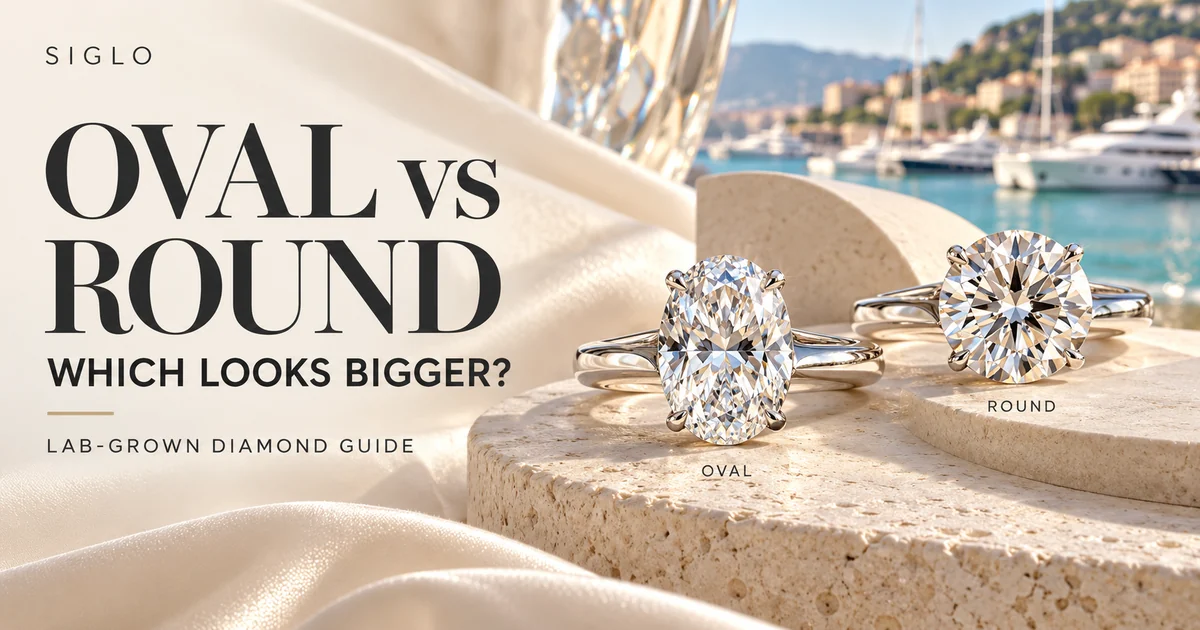
An oval diamond is worth considering if you enjoy an elongated outline and noticeable finger coverage. A round diamond suits someone who prefers a circular, balanced look. Both can be beautiful; the individual stone and setting matter as much as the shape.
| Feature | Oval Diamond | Round Diamond |
|---|
| Outline | Elongated with rounded ends | Circular and symmetrical |
| Visual presence | Can appear larger at the same carat weight | Creates a balanced circular appearance |
| Style on the hand | Can create the impression of longer fingers | Offers a compact, evenly proportioned outline |
| What to inspect | Dimensions, outline, symmetry and central dark areas | Dimensions, proportions and light performance |
| Budget comparison | Compare the actual stone and complete ring | Compare the actual stone and complete ring |
For more information about how different outlines affect appearance, explore GIA's guide to diamond shapes.
Which Diamond Shape Looks Bigger?
Oval diamonds can appear larger than round diamonds of the same carat weight because of their elongated outline and face-up spread. However, shape alone does not guarantee that one particular diamond will look bigger than another.
Carat measures weight, rather than visible dimensions. When comparing two rings, ask for the center stone's measurements in millimeters and review photographs taken at a similar scale. Learn more through GIA's explanation of diamond carat weight.
For example, an oval described as 8mm long and 5.5mm wide has a longer outline than a round stone measuring 6.5mm across. These are illustrative measurements, not specifications for a SIGLO product. The longer dimension does not, by itself, prove greater overall face-up area or a higher carat weight.
In your own comparison, look at both length and width. Then consider how the ring appears on a hand similar to yours.
Oval vs Round Diamonds: Which Sparkles More?
A round brilliant and an oval brilliant can both display attractive sparkle. Choosing a shape is only the beginning: the cutting quality, facet arrangement and viewing conditions influence the appearance of the individual diamond.
With an oval, pay particular attention to the bow-tie effect—a darker pattern that can appear across the center. Its visibility varies. A photograph taken under flattering lighting may not tell the whole story, so ask to see the stone moving under different lighting conditions. GIA's oval diamond guide explains this feature.
When shopping online, request a short video or several clear views if available. Watch how the stone changes as it moves. Choose the appearance you enjoy rather than assuming that every round diamond outperforms every oval.
How Lab-Grown Diamonds Can Stretch Your Budget
Lab-grown diamonds and natural diamonds share the same carbon crystal structure and nearly the same chemical, physical and optical properties. Their growth origin differs. Lab-grown diamonds are diamonds; moissanite and cubic zirconia are different materials. Read GIA's explanation of lab-grown diamonds and simulants.
Lab-grown options are often available at a lower price point than comparable natural diamonds. This can create room in your budget for a larger stone or a design with more visual presence. The exact difference depends on the stones and the complete pieces being compared.
A larger diamond still needs to look beautiful to you. Keep the stone's appearance, setting and fit in the decision. A higher carat number alone does not guarantee stronger sparkle.
For a fair price comparison, look at similar shape, weight, quality information and metal. Do not compare the price of a loose stone with a finished ring, or assume that differently colored diamonds are equivalent.
The Setting Also Changes How Big a Ring Looks
A center stone is only part of a ring's overall appearance. A halo can create a broader sparkling outline, while side stones can extend the design across the finger. These details change the visual presence of the ring without changing the center stone's weight.
GIA discusses these effects in its guide to settings that make a diamond ring look bigger.
Compare the entire ring in front and side views. Consider the setting height, band width and how the piece will fit into your daily routine. A dramatic design may suit someone who enjoys statement jewelry, while a simpler setting may feel more comfortable to someone who prefers understated pieces.
Explore an Oval Lab-Grown Diamond Ring at SIGLO
The Solaris Flame orange lab-grown diamond ring offers an example of an expressive oval design. The product listing describes an 8ct oval lab-grown orange center diamond, geometric side stones and a pavé-accented S925 sterling silver setting.
Its listed price is $260, with US sizes 5–9. The warm orange color makes it an option to explore if you want your ring to become a focal point.
This is a product example, rather than a matched oval-versus-round price comparison. Prices, specifications and availability may change; check the product page before ordering and include any applicable delivery charges or taxes in your budget.
SIGLO's designs bring together lab-grown diamond options, colored gemstones and silver settings. Read each product's stone description carefully when browsing the SIGLO ring collection.
How to Choose Between an Oval and a Round Diamond
- Choose your preferred outline: elongated oval or balanced circle.
- Compare measurements: look beyond the carat number.
- Review the appearance: ask for clear photographs and a video when available.
- Inspect the complete setting: consider height, proportions and comfort.
- Check documentation: confirm whether an independent stone report is included.
- Compare final prices: include the selected size, metal and any additional charges.
- Read return terms: understand sizing, customization and return conditions before buying.
Frequently Asked Questions
Do Oval Diamonds Always Look Bigger Than Round Diamonds?
No. Ovals can offer a larger-looking outline at the same carat weight, but the actual dimensions, proportions and setting determine the comparison.
Are Lab-Grown Diamonds Less Sparkly?
Laboratory origin alone does not make a diamond less sparkly. Compare the individual stone's cutting quality and visible appearance.
Can I Buy a Larger Diamond for the Same Budget?
A lower-priced lab-grown option may make a larger stone accessible. Compare current listings and keep quality, setting and fit in the decision.
Which Shape Is Better for Everyday Wear?
Choose the complete ring that suits your routine. Setting height, comfort, secure construction and care requirements all matter.
Find the Shape That Gives You More of What You Love
The choice between oval vs round diamonds comes down to the appearance you prefer and the details of the ring in front of you. An oval may appeal if you enjoy an elongated silhouette; a round may suit you if you love a balanced circular shape.
Explore the Solaris Flame oval lab-grown diamond ring, or browse SIGLO's ring collection to compare styles.
Your budget can guide the choice without defining the beauty of the piece. Look for the shape, sparkle and design you will enjoy wearing.