Lab-grown diamonds vs natural diamonds is one of the most important comparisons for today’s jewelry buyers. Both can deliver exceptional brilliance, hardness and timeless beauty. However, their origin, rarity, price and long-term market value are different.
For buyers who want a larger stone, vivid color or more impressive design without paying the traditional mined-diamond price, lab-grown diamonds offer a new form of smart luxury. In some like-for-like market comparisons, they may cost close to one-tenth of comparable natural diamonds. Exact savings vary by carat, cut, color, clarity, setting and retailer.
Diamond Brilliance Without the Traditional Price
Choose the sparkle, size and design you truly love—without letting the traditional diamond price define your moment.
Are Lab-Grown Diamonds Real Diamonds?
Yes. Lab-grown diamonds are real diamonds created through advanced technology rather than geological formation beneath the earth.
According to GIA, laboratory-grown diamonds have essentially the same chemical composition, crystal structure, optical properties and physical properties as natural diamonds. Both consist of crystallized carbon and can display the brilliance, fire and durability associated with diamond.
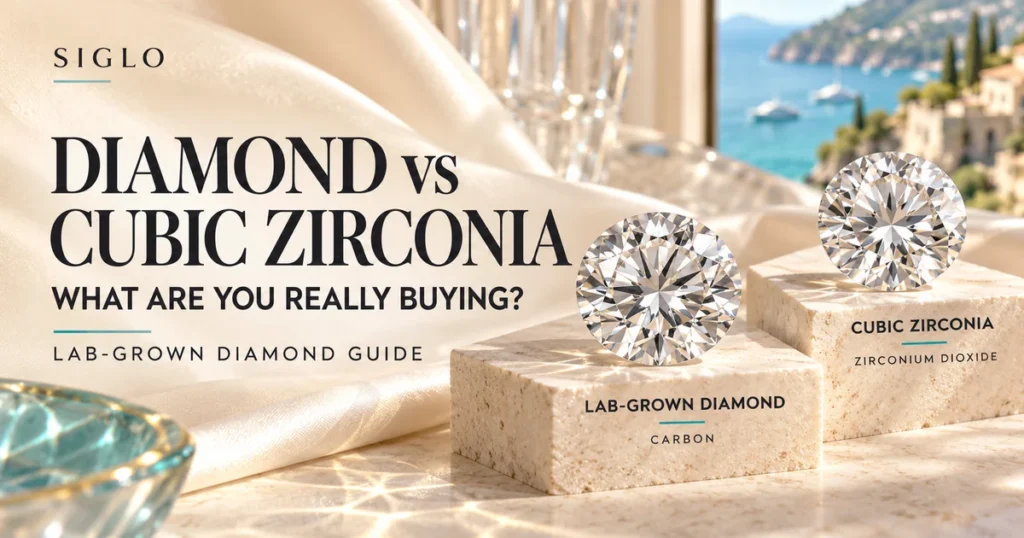
Therefore, lab-grown diamonds are not cubic zirconia, glass or imitation stones. They are also different from moissanite, which is a separate gemstone with a different chemical composition.
Learn more from the official GIA guide to lab-grown diamonds and diamond simulants.
Lab-Grown Diamonds vs Natural Diamonds: The Main Difference
The most important difference is origin.
- Natural diamonds form deep within the earth through geological processes over an extremely long period.
- Lab-grown diamonds form in controlled environments through technologies such as CVD or HPHT.
Because their growth histories differ, trained gemological laboratories can identify them using specialized instruments. However, their visual appearance may be extremely similar, and they can be difficult to distinguish through ordinary observation alone.
Do Lab-Grown Diamonds Have the Same Sparkle?
A well-cut lab-grown diamond can display the same type of brilliance, fire and scintillation that buyers expect from a well-cut natural diamond.
Sparkle does not depend only on whether a diamond comes from the earth or a laboratory. Instead, visible beauty depends heavily on:
- Cut quality
- Facet proportions
- Polish and symmetry
- Color and clarity
- Lighting conditions
- The design of the jewelry setting
As a result, a beautifully cut lab-grown diamond may look more brilliant than a poorly cut natural diamond. Buyers should compare the complete stone rather than focusing only on origin.
Why Are Lab-Grown Diamonds More Affordable?
Natural diamonds depend on mining, geological rarity, sorting, international distribution and a long traditional supply chain. Lab-grown diamonds use controlled production methods that can create gem-quality material more efficiently.
As technology improves and production becomes more scalable, lab-grown diamond prices have become increasingly accessible. Therefore, buyers can often choose a larger carat weight, higher visual clarity or more elaborate setting while staying within the same budget.
Can They Really Cost About One-Tenth of the Price?
In some market comparisons—especially for larger stones—lab-grown diamonds may cost up to approximately 90% less than comparable natural diamonds.
However, this should not be treated as a fixed guarantee. The final price difference depends on:
- Carat weight
- Diamond shape
- Cut quality
- Color and clarity
- Grading report
- Metal and setting
- Side stones
- Brand and craftsmanship
The most accurate message is not that every lab-grown diamond costs exactly one-tenth of a natural diamond. Instead, it is that lab-grown diamonds can deliver genuine diamond properties and comparable visual brilliance at a substantially more accessible price.
Lab-Grown vs Natural Diamond Comparison
| Feature | Lab-Grown Diamond | Natural Diamond |
|---|
| Material | Crystallized carbon | Crystallized carbon |
| Optical Properties | Essentially the same | Traditional diamond properties |
| Hardness | Diamond hardness | Diamond hardness |
| Origin | Created through CVD or HPHT technology | Formed through natural geological processes |
| Appearance | Can appear visually indistinguishable | Classic natural diamond appearance |
| Price | Usually significantly more affordable | Higher due to rarity and traditional market positioning |
| Carat for the Same Budget | Often allows a larger center stone | Usually a smaller stone at the same budget |
| Resale Market | Generally limited and price-sensitive | Usually stronger, although resale is never guaranteed |
| Best For | Wearers prioritizing size, design and accessible luxury | Buyers prioritizing geological rarity and traditional value |
Which Diamond Offers Better Value?
The answer depends on what “value” means to you.
If value means geological rarity, traditional symbolism and a more established resale market, a natural diamond may suit your priorities.
However, if value means receiving more visible size, brilliance, color and design for your budget, a lab-grown diamond may offer the stronger choice.
Many modern buyers prefer to spend less on the stone and use the remaining budget for:
- A larger center diamond
- A halo or three-stone design
- Pink, yellow, blue or teal color
- A wedding or honeymoon
- A meaningful anniversary experience
- Savings for a home or future goals
Can Anyone Tell the Difference by Looking?
Ordinary visual inspection is not a reliable method for determining diamond origin. GIA explains that laboratory-grown and natural diamonds may appear very similar because their core properties are essentially the same.
Professional laboratories use advanced instruments to examine growth structures, fluorescence patterns, inclusions and other diagnostic features.
For greater buying confidence, review the grading report, report number and laser inscription when available. Read our GIA lab-grown diamond report guide for more information.
How to Choose a Beautiful Lab-Grown Diamond
Prioritize Cut
Cut quality has one of the strongest effects on visible sparkle. Look for balanced proportions, attractive facet patterns and lively light return.
Choose an Eye-Clean Clarity
You do not always need the highest possible clarity grade. A diamond that appears clean without magnification may provide better value for everyday wear.
Select the Right Shape
Round diamonds offer classic brilliance. Oval and pear shapes visually lengthen the finger, while emerald cuts create clean architectural elegance. Radiant and cushion cuts combine structured outlines with lively sparkle.
Consider the Complete Ring
The center diamond is important, but the setting also shapes the final appearance. Halo designs create a larger visual effect, while side stones and pavé bands add dimension and brilliance.
Explore our lab-grown diamond 4Cs guide before selecting your stone.
Why S925 Silver Makes Diamond Luxury More Accessible
Pairing a lab-grown diamond with S925 sterling silver can reduce the total price of a ring while preserving a bright silver-white fine jewelry appearance.
S925 sterling silver contains 92.5% silver and offers a polished cool-toned finish that complements white, pink, yellow and blue-green stones. It is especially suitable for customers who want a statement ring without the higher cost of platinum or solid gold.
The result is a jewelry piece that delivers:
- Diamond brilliance
- A refined silver-white appearance
- Modern and elegant design
- More accessible pricing
- Comfortable everyday styling
Colored Lab-Grown Diamonds: More Personality for Your Budget
Lab-grown technology also makes colorful diamond-inspired luxury more accessible. Pink, yellow, blue and teal stones allow buyers to express personality rather than choosing only traditional white jewelry.
At SIGLO, our ring collection includes elegant white stones, romantic pink designs, vivid ruby tones and ocean-inspired blue-green center stones. These pieces are created for anniversaries, engagements, birthdays, milestones and refined everyday wear.
Why Shop SIGLO Lab-Grown Diamond Jewelry?
SIGLO focuses on accessible fine jewelry with striking center stones, polished S925 sterling silver and designs created to make every meaningful moment feel more luminous.
Selected SIGLO rings offer:
- High-impact lab-grown diamond and gemstone designs
- S925 sterling silver settings
- White, pink, yellow, ruby and blue-green color options
- Classic solitaire, halo, floral and three-stone styles
- US ring sizes 5–10 on selected designs
- Gift-ready packaging
- Quality inspection before dispatch
- Long-term jewelry care
Please leave your preferred ring size in the order notes at checkout. Selected orders are processed within 1–3 business days.
Browse the SIGLO ring collection or explore our complete jewelry collection.
The Diamond Look You Love—Without the Traditional Price
Why settle for a smaller design when your budget can create something more memorable?
Discover brilliant lab-grown diamond rings designed for engagements, anniversaries, meaningful gifts and elegant everyday wear.
Explore Lab-Grown Diamond Rings
Buying Emotion: Spend on the Life You Want to Celebrate
A diamond should symbolize love, confidence and a meaningful chapter—not financial pressure.
Choosing a lab-grown diamond does not mean choosing less beauty. It means deciding where your money creates the most value: a larger design, a memorable journey, a new home, an anniversary or a gift to yourself.
The right ring is not defined by how much tradition says you should spend. It is defined by how it makes you feel every time the light touches it.
Frequently Asked Questions
Are lab-grown diamonds fake?
No. Lab-grown diamonds are real diamonds with essentially the same chemical composition, crystal structure and physical properties as natural diamonds.
Do lab-grown diamonds sparkle like natural diamonds?
Yes. A well-cut lab-grown diamond can display the same type of brilliance, fire and scintillation as a well-cut natural diamond.
Can lab-grown diamonds cost 90% less?
In some comparisons, particularly for larger carat weights, the price difference may approach 90%. However, the exact savings depend on quality, size, setting and retailer.
Can people tell the difference by looking?
Usually not through ordinary visual inspection alone. Specialized gemological equipment can identify differences in growth origin.
Do lab-grown diamonds have resale value?
They may have some resale value, but their secondary market is generally less established and more price-sensitive than the natural diamond market. Buy the ring primarily for wearing, enjoyment and emotional meaning rather than as a guaranteed investment.
What size rings does SIGLO offer?
Selected SIGLO rings are available in US sizes 5–10. Please leave your preferred size in the order notes during checkout.
Official Educational Sources
GIA: Simulants, Moissanite and Lab-Grown Diamonds
GIA: Natural and Laboratory-Grown Diamond Differences
FTC: Diamond and Jewelry Advertising Guidance